A 30-day skincare reset · PDF ebook

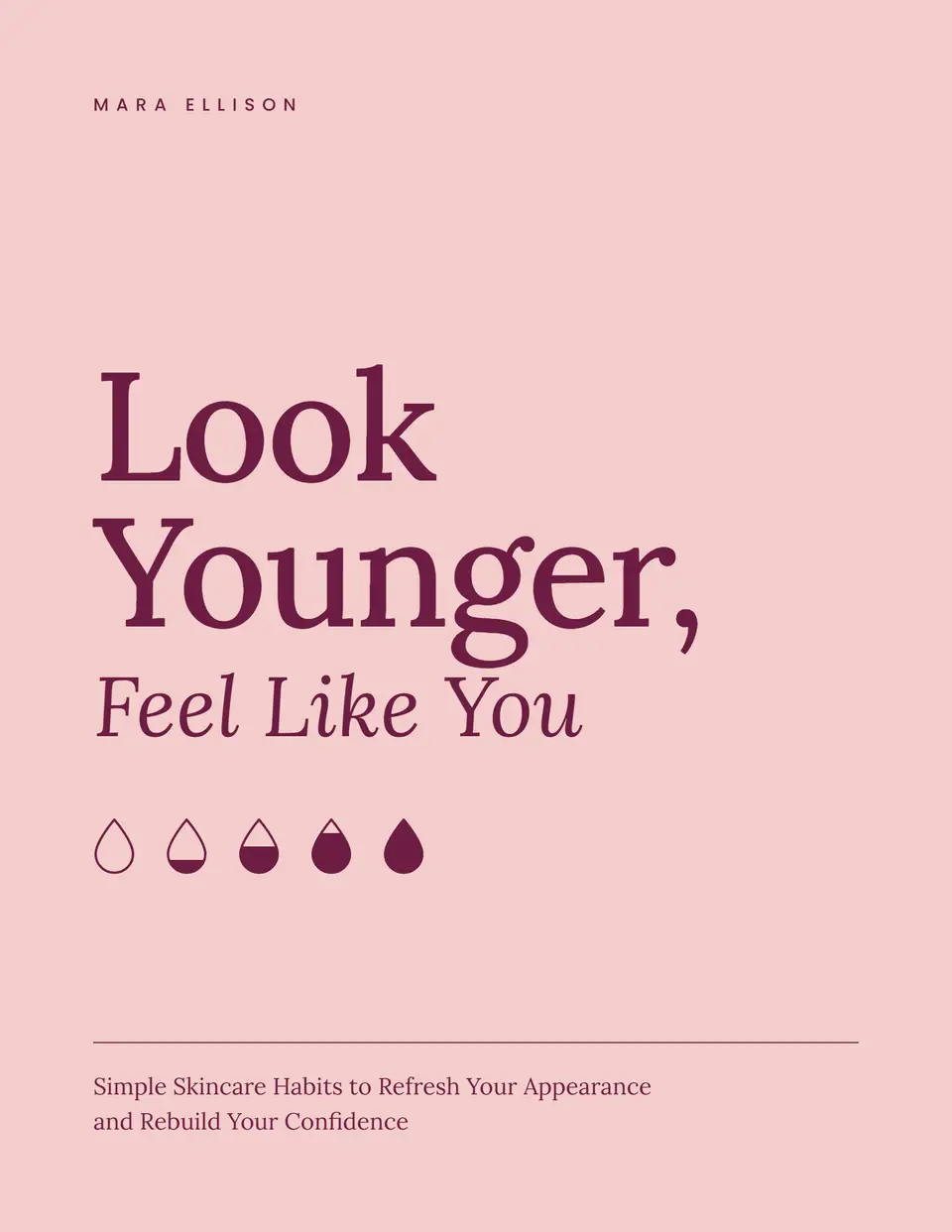
Look Younger, Feel Like You

Simple Skincare Habits to Refresh Your Appearance and Rebuild Your Confidence

Mara Ellison

Cover of Look Younger, Feel Like You by Mara Ellison: plum lettering on a blush background above a row of five water drops, each one fuller than the last.
  • A 30-day reset, a few minutes a day
  • Ingredients labeled by strength of evidence
  • Printable planners and trackers

Sound familiar?

Eleven bottles on the shelf, and still no idea what's working.

7:40 a.m.

The cabinet door swings open. Three serums she can't tell apart. A vitamin C that turned the color of weak tea last spring. A retinol she used twice, until her cheeks stung. The lines at the corners of her eyes look deeper in this light, and her skin feels tight after washing, which never used to happen. She pats on some moisturizer and thinks: I honestly don't know what I'm doing anymore.

Many women reach their late thirties, forties, or fifties with a cabinet full of products and less confidence than they had at twenty-five. Not because they stopped caring, but because so many voices have told them so many different things.

Routines grew from three steps to ten. Every season brings a new serum you are told you need, and a new rule about what you must never mix. Meanwhile, the habits with the strongest evidence behind them are few, often affordable, and not especially glamorous.

This book makes it simple again.

What skincare can do, and what it can't

The book starts with an honest line, because it shapes every decision you make afterward. Knowing it protects your wallet and your peace of mind.

Skincare can help with

  • Comfort, dryness, and tightness
  • The look of fine lines, gradually
  • Rough texture and dullness
  • A more even-looking tone over time
  • Protection from further sun damage

Skincare can't change

  • The shape of your bones
  • Deep folds and significant sagging
  • Lost facial volume
  • Your genetics and skin tone
  • Years of time, in reverse

If a change that bothers you is beyond what skincare can do, you can talk to a board-certified dermatologist about in-office options, or simply decide it doesn't need fixing at all. Both are good choices.

Skincare is not a moral obligation. It's a form of care, and you get to decide how much of it you want.

From the introduction

What's inside

Four parts, built to be used

Read it straight through, or start tonight with the chapter that matches where you are.

  1. Part I

    Understand your skin

    How skin changes with time, how to tell what yours actually needs, and how to see through beauty marketing.

    • Your Skin Is Changing, and That Is Normal
    • Know Your Skin Before You Buy Another Product
    • The Beauty Industry vs. What Your Skin Actually Needs
  2. Part II

    Build your essential routine

    A morning routine, an evening routine, the ingredients worth knowing, and the art of doing less.

    • The Morning Routine That Makes Sense
    • The Evening Routine That Works for Real Life
    • The Ingredients Worth Understanding
    • The Art of Doing Less
  3. Part III

    Real women, real life

    What can change after 35, 40, and 50, smarter responses to common concerns, and confidence without the pressure.

    • When Your Skin Feels Different After 35, 40, or 50
    • Common Concerns, Smarter Responses
    • The Habits That Support Your Skin
    • Beauty Without the Pressure
  4. Part IV

    Your personal reset

    A gentle 30-day reset, then a plan that carries your routine through the year ahead.

    • Your 30-Day Skincare Reset
    • Your Skincare Plan for the Next Year

Plus, at the back

  • Myths and Facts
  • Frequently Asked Questions
  • Skincare Glossary
  • Your Skincare Toolkit
  • Questions to Ask a Dermatologist
  • References and Further Reading

Part IV

A gentle 30-day reset

One small action a day, most of them five minutes or less. Not a transformation, but something more useful: a routine your skin likes and habits you can keep.

  1. Week one · Days 1 to 7

    Reset

    Clear the shelf, step back to the core routine, and make sunscreen automatic.

    • Gather every product and count them
    • Sort into Keep, Pause, and Pass
    • Choose your core three
    • Do the Bare-Face Check
  2. Week two · Days 8 to 14

    Build

    Make your routine sturdy enough to survive real life.

    • Write your morning and evening routines
    • Plan a tired-night version
    • Pick the one concern that matters most
    • Practice the 48-hour rule
  3. Week three · Days 15 to 21

    Refine

    See how your skin is doing and decide, cautiously, whether to add anything.

    • Stay with the core if your skin isn't calm
    • Choose one optional active, or none
    • Patch test before it touches your face
  4. Week four · Days 22 to 30

    Sustain

    Start slowly, look back, and write the routine you'll keep.

    • Extend care to your neck, chest, and hands
    • Fill in the monthly budget planner
    • Repeat the Bare-Face Check
    • Set a three-month check-in
  • A few minutes a dayMost daily actions take five minutes or less.
  • One change at a timeAdd one new product, and especially one active, at a time.
  • Missing a day is finePick up where you left off. A blank box is just a day.

Honest about evidence

Every claim, labeled by its evidence

Not every skincare claim stands on the same ground. The book rates ingredients and habits on four simple levels, so you can see what's well supported and what's mostly a sales pitch.

  1. Strong

    Repeated, well-designed studies in people point the same way.

    In the book: Daily broad-spectrum sunscreen to help prevent photoaging. Prescription tretinoin for the look of sun-related fine lines.

  2. Moderate

    Good human studies, but fewer or smaller ones, or ones that measured only some outcomes.

    In the book: Over-the-counter retinol, niacinamide, topical vitamin C, and alpha hydroxy acids for some visible signs of aging.

  3. Emerging

    Interesting early results that are small, short, or mostly from the lab.

    In the book: Many peptides, plant extracts, and newer "biotech" ingredients.

  4. Mostly marketing

    Bold claims, with thin or missing published evidence in people.

    In the book: Creams that claim to add collagen to your skin, "detox" masks, and luxury add-ins like gold or caviar.

These labels are a guide, not a verdict. Results also depend on the formula, how much of an ingredient it contains, and how consistently you use it.

Tools

Tools that make it simple

Each one is small enough to use on a busy morning or a tired night.

  • The Core Three

    A gentle cleanser, a moisturizer, and a broad-spectrum sunscreen with SPF 30 or higher. The routine everything else builds on.

  • The Shelf Audit

    Sort everything you own into Keep, Pause, and Pass, without wasting money or guessing.

  • The 48-Hour Rule

    Want a new product? Wait two days. If you still want it and it passes the checklist, enjoy it.

  • The Bare-Face Check

    A few minutes in good light with clean skin, to see what your skin actually needs.

  • The Tired-Night Routine

    A two-step version for the nights when the full routine isn't going to happen. Both count.

  • The Patch Test

    Several days on a small, discreet area before any new active goes on your face.

Print at home

Your skincare toolkit

  • A 30-day checklist and habit tracker
  • Morning and evening routine planners
  • An ingredient introduction tracker
  • A product-shopping checklist and monthly budget planner
  • A skin comfort journal and questions to ask a dermatologist

Print what you'll use, and skip the rest.

Instead of, try

A smarter first move

The book is full of small course corrections for the moments when it's tempting to buy your way out. Here are three.

When irritated skin needs help

Instead of

Buying a "barrier repair" kit with five new products to fix irritated skin.

Try

Using the three products you already know your skin tolerates, and nothing else, until it feels comfortable again.

The Art of Doing Less · Chapter 7

When your skin starts to change

Instead of

"My skin is falling apart. I need a whole new routine for mature skin."

Try

"My skin has changed. I'll make my cleanser gentler, my moisturizer richer, and my actives slower."

After 35, 40, or 50 · Chapter 8

When a new active stings

Instead of

Pushing through stinging because the plan says it's an active night.

Try

Skipping the active, going back to the core routine for a week, and writing down what happened.

Your 30-Day Reset · Chapter 12

Look inside

Read the Shelf Audit from the book

Excerpts from Chapter 7, The Art of Doing Less, in the book's own words. It's one of the simplest ways to start.

Chapter 7 · The Art of Doing Less

The Shelf Audit

This is a practical way to simplify an overloaded routine without wasting money or guessing.

  1. Gather everything. Bring every skincare product you own to one place: bathroom, bedroom, gym bag, travel kit, and the back of the drawer.
  2. Check the dates. Look for expiration dates and the period-after-opening symbol. Anything expired, separated, discolored, or smelling odd goes into the PASS pile.
  3. Name each product's job. For each item, write one word: cleanse, moisturize, protect, or treat. If you can't name its job, it goes into PAUSE.
  4. Find the duplicates. If you have three moisturizers, keep the one your skin likes best and PAUSE the others to use up later, one at a time.
  5. Pull out the actives. Put every product with a retinoid, exfoliating acid, or strong vitamin C into PAUSE for now. You'll bring back one, later, on purpose.
  1. Remove the irritants. Anything that has stung, burned, or caused redness goes into PASS, even if it was expensive.
  2. Build your core. From the KEEP pile, choose one gentle cleanser, one moisturizer, and one sunscreen. That's your routine for now.

PAUSE doesn't mean failure, and it doesn't mean waste. It means "not now." Store those products somewhere cool and dark.

The core routine

Morning
Gentle cleanser or water rinse, moisturizer, broad-spectrum SPF 30 or higher
Evening
Gentle cleanser (with makeup removal if needed), moisturizer

What to tell yourself

“Doing less isn't giving up. It's how I find out what actually works.”

“My skin doesn't need to be busy to be cared for.”

“I can always add one thing back. I can't easily undo irritation.”

That's one section of thirteen chapters. The book takes you from here to a routine you'll keep all year.

Get the ebook

Myths and facts

Myths and facts

The book ends with twelve common beliefs and what the evidence actually says. Four of them:

  • Myth

    If it tingles, it's working.

    Fact

    Stinging and burning are signs of irritation, not effectiveness. Stop products that sting or burn, unless a dermatologist prescribed them and knows how your skin is reacting.

  • Myth

    Expensive products work better.

    Fact

    Price reflects packaging, branding, and marketing as much as formulation. Well-formulated products exist at every price point.

  • Myth

    Collagen creams add collagen to your skin.

    Fact

    Collagen molecules in creams are too large to replace the collagen in your skin's deeper layer. They can moisturize the surface, but they don't rebuild collagen.

  • Myth

    You need a different routine for every decade.

    Fact

    Gentle cleansing, moisturizing, and sun protection stay the same at every age. What changes are textures, gentleness, and whether you use an active.

Is it for you?

Who this book is for

  • Women roughly 35 to 55 who notice their skin behaving differently than it used to
  • Anyone who has stood in a store holding two serums, unable to tell which one does what
  • Busy women who want a routine that holds up on their most tired days
  • Readers who want honest answers, not before-and-after promises

Written for

  • Late 30s
  • 40s
  • 50s and beyond
  • Every skin tone
  • Every skin type
  • Busy mornings

Questions

Before you buy

Anything else? Get in touch.

What exactly do I get?

A 233-page PDF ebook in four parts: understanding your skin, building your essential routine, real-life changes after 35, and a gentle 30-day reset with a plan for the year ahead. It includes myths and facts, a glossary, a full printable toolkit, and questions to take to a dermatologist.

How do I get the book after I buy it?

Checkout happens on Beacons. After payment you get a download link for the PDF right away. It works on a phone, tablet, or computer, and the planners print on standard letter paper.

Will this make me look younger?

The book won't reverse aging, and no book or cream can. It will help you build a routine that leaves skin more comfortable and protected. Over months of consistent care, many women also see smoother texture, a more even tone, and softer fine lines. Those changes are gradual and look different on every face.

Do you recommend brands?

No. Formulas change and the right choice depends on your skin and budget. Instead, the book shows you what to look for, so you can judge any product on any shelf yourself.

How many products will I need?

For most women, three: a gentle cleanser, a moisturizer, and a broad-spectrum sunscreen with SPF 30 or higher. One optional treatment and one optional antioxidant cover almost every other goal.

Is it too late to start at 50 or 60?

No. It's never too late to protect your skin from further sun damage, to make it more comfortable, or to gradually improve its texture and tone.

What if the book doesn't help me?

Email thebetterarchive@gmail.com within 7 days of your purchase and we'll refund you in full. You don't need to give a reason.

Is this medical advice?

No. It's an educational guide to everyday skincare. If you have a skin condition, are pregnant or breastfeeding, or notice a spot that's new, changing, or not healing, please see a qualified clinician.

I have a problem with my order. Who do I contact?

Email thebetterarchive@gmail.com and we'll help you sort it out.

Cover of Look Younger, Feel Like You by Mara Ellison: plum lettering on a blush background above a row of five water drops, each one fuller than the last.

Start with your shelf tonight.

Don't buy anything tonight. Don't throw anything out yet, either. Just open your cabinet, look at what's there, and read the first few pages.